
Kaupapa Frameworks are the essential guiding architecture for everything from whānau through to schools through to organisations through to the planet. Here Dr Hirini Kaa our Kaiwhakatō (Director) shares some thoughts around these, and how we can live them our ourselves.
Introduction
The world is increasingly chaotic. From war in Europe to political assassinations in the US to technology disrupting the world economy through to the nature of truth itself.
The relative peace and prosperity that we have been used in in the West since World War Two is coming to an end, as the global frameworks that have maintained that peace and prosperity begin to unravel. Yes it was unfair for much of the world and yet it did alleviate poverty for billions. And working-class Aotearoa could buy a house on a working-class salary.
 This unwinding of frameworks has been happening for some time, and Koi Tu points out the interwoven nature of the social fabric of liberal democracies like New Zealand has been progressively undermined over time.[1]
Organisations, whether global institutions through to nations, through to businesses, through to whānau, need order. Humanity prefers order to chaos. Māori have been consistently and conspicuously portrayed throughout history of Aotearoa-New Zealand especially in the media as reckless, uncaring, ram-raiding and generally chaotic.
However in reality the Māori worldview is based on rigidly structured social and cultural frameworks. We call it tikanga, based on the word tika or correctness. From everyday personal interactions through to humanities interaction with the environment and with creation, the Māori worldview seeks to maintain correct relationships guided by ancient frameworks.
Understanding these frameworks of relationships is key to the success of any organisation, be it whānau through to society. Understanding and then living them out deeply, with common understandings of values that underpin relationships, and guide interactions and decision making.
Te Kākano Leadership Institute defines these as Kaupapa Frameworks. To speakers of te reo Māori this might seem a tautology, however we define kaupapa as both ‘kau’ (to appear for the first time), and papa (foundation) so Kaupapa are ‘ground rules, first principles, general principles’. Kaupapa Frameworks are then ‘the guiding architecture for an organisation grounded in mātāpono (values) which shape practice.’
The practical question is how do leaders work with Kaupapa Frameworks? How do they operate within, change, shape, build these? These frameworks are ever present, either articulated or not. It is crucial to name and shape reality as leaders. And a key role of leadership is to create form out of chaos, and to maintain an agreed order so that the people, and the world, may flourish.
Organisations, whether global institutions through to nations, through to businesses, through to whānau, need order.
Creation Stories as a Framework
Taken at large, Kaupapa Frameworks are as ancient as humanities’ contemplation of the cosmos, giving shape to existence.
Creation stories, or creation myths, are extremely powerful narratives for people. They lay out the purpose of our existence – what we are here for, what we are meant to do, who we are meant to be.
This is not to have a debate of science versus faith. The American scholar Joseph Campbell wrote of creation myths as ‘psychologically symbolic. Its narratives and images are to be read, therefore, not literally, but as metaphors.’[2] “Myth” does not mean for Campbell “untrue”, rather it has a purpose and deep impact on our identity as humans.
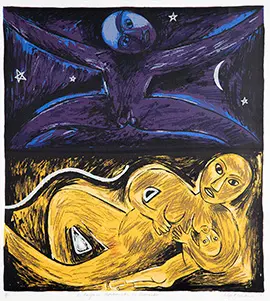
Ranginui me Papatuanuku me Ruaumoko by Robyn Kahukiwa
Personally I am entirely comfortable holding multiple creation narratives in my head and heart, because different explanations have different purposes. The Big Bang, for example, is a scientifically provable explanation that speaks into my life about physics, entropy and the eventual heat loss death of the Universe. In this, we are all products of stardust and to star dust we shall return.
The Judeo-Christian creation story in Genesis, on the other hand, holds other lessons for me.
1 When God began to create the heavens and the earth, 2 the earth was complete chaos, and darkness covered the face of the deep, while a wind from God swept over the face of the waters. 3 Then God said, “Let there be light,” and there was light. 4 And God saw that the light was good, and God separated the light from the darkness. 5 God called the light Day, and the darkness he called Night. And there was evening and there was morning, the first day.
The biblical scholar Walter Brueggemann notes that this narrative implies that chaos was already present in the world. ‘God did not create “from nothing” but God’s act of creation consists in the imposition of a particular order upon that mass of undifferentiated chaos’. In saying this, Brueggemann is asserting that creation is not one act ‘but by the endless reenactment and reassertion of a sovereign will over the recalcitrant “stuff” of chaos’[3]
Our most common creation story in Te Ao Māori is of course Ranginui and Papatuanuku. There are stages of creation, from Te Kore (the nothingness) through to Te Pō (the chaotic energy in the darkness) and then the appearance of light, shape and order in the masculine and feminine energies of Ranginui and Papatuanuku.
Their relationship with their seventy children, and the feats and works of those children, give us a cultural framework to live by. The interconnectedness of creation is reinforced through these stories, and the need to recognise the tapu of the entirety of creation and to respond accordingly, whether to people, to the environment or to the gods themselves (creation).
The Ngai Takoto scholar and elder Maori Marsden describes how in telling these stories our ancestors ‘created sets of symbols to provide them with the maps/models to portray each state in this evolutionary process. These representations were the means by which they could apprehend/grasp/interpret/reconcile the various worlds; and grasp what they perceived as ultimate reality’[4]
In our Western world we have become unique in that we don’t reflect on our creation stories. In our highly compartmentalised world even contemplating the Big Bang is reserved for scientists undertaking their labour. Western societies have set aside creation as a guiding principle in life, living instead from moment to moment. Even here in Aotearoa, the fascination in things Māori has a secular quality to it, becoming so rarified in its symbolism that it has very little impact on daily lives.
Western societies have set aside creation as a guiding principle in life, living instead from moment to moment.
Living out Creation Frameworks
Here in Aotearoa Māori live out these creation frameworks in our everyday life and ritual.
Tapu is one of the deepest concepts in Te Ao Māori. It has several meanings, and revered Te Rarawa scholar Henare Tate outlines three: restrictions of access; the depth of being-in-itself; and being-in-relationships with the rest of creation.
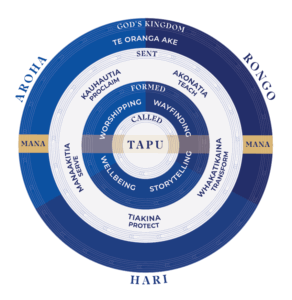
St John College use Pa Henare Tates work on Tapu in their formation framework
Tapu is often translated as sacred or divine, and this works in some circumstances. However Tate writes of tapu in a much more holistic sense, where ‘Tapu denotes the wholeness, the totality, the fullness of existence.’[5]
Tapu is derived from creation. It is essentially an essence of the gods, and he closer we are to creation, the more tapu things become. So for instance an elder line of descent is more tapu because it is chronologically closer to creation. Death is also highly tapu because an individual (and the whanau pani/grieving family) cross the line of creation, bringing it into close contact. And on a daily basis, I wouldn’t put food near my head or place my hat on the table because my head is highly tapu.
Hence the creation framework interweaves itself into our everyday lives.
Of course this way of thinking is challenged considerably by colonisation and the challenges of modernity. Colonisation is an ongoing attempt to replace our cultural values with others. In mainstream schooling we don’t just learn facts, it has always been a place where values were inculcated into us. Education is an ongoing site of cultural conflict.[6]
And in the modern world these values are often difficult to live out due to the changed material reality of our people. Our highly tapu death processes become truncated because of the economic pressures we are under. We get offered a coffee while having our hair cut, and the hair gets thrown into the rubbish. Our cultural frameworks, derived from creation, need to constantly respond and react to changing environments.
Policy Frameworks
The nature of Kaupapa Frameworks can be challenging in a policy setting, partly due to their ubiquitousness.
There is no generally accepted definition of a “policy framework.” This is partly due to their ubiquitousness, being used everywhere and their nature being taken as almost self-explanatory, or essentially their purpose being conflated with their nature.[7]
Another reason for the challenge of definition is because these frameworks can by their nature be extremely diverse. They can be either used internally within an organisation to regulate action or used externally to influence other organisations. They can be very small for a small organisation or very large. The United Nations Sustainable Development Goals[8] for example, are a framework of immense global proportions seeking to influence many parts of the planet. Your local school charter is another, very local framework for a particular school.
Policy frameworks also generally work around a set of individual policies, being guidelines that seek consistency, compliance, and effective decision-making within an organisation. Having said that, policy is a very broad topic in itself. Public policy has been defined by Thomas Dye as ‘anything a government chooses to do or not to do.’[9] Maryno Lakhno describes policy frameworks as ‘guiding structures for policy creation and implementation’, or if policy is a brick, policy framework is the wall of bricks that stabilises the house.[10]
Its also useful to distinguish between frameworks and other forms of analysis. According to Elinor Ostrom it is useful to differentiate between Frameworks as the most general form of analysis ‘provide a metatheoretical language for identifying universal elements and generating relevant questions’; Theories, which focus on specific parts to diagnose and assist; and Models which contain precise assumptions.[11]
Broad as they are, frameworks need to land somewhere as a definition. Lakhno defines policy frameworks as: ‘general structures, often encapsulated in documents or established practices, that provide institutions a guiding architecture for policy action across one or multiple policy areas.’[12]
He Ara Waiora as a Kaupapa Framework
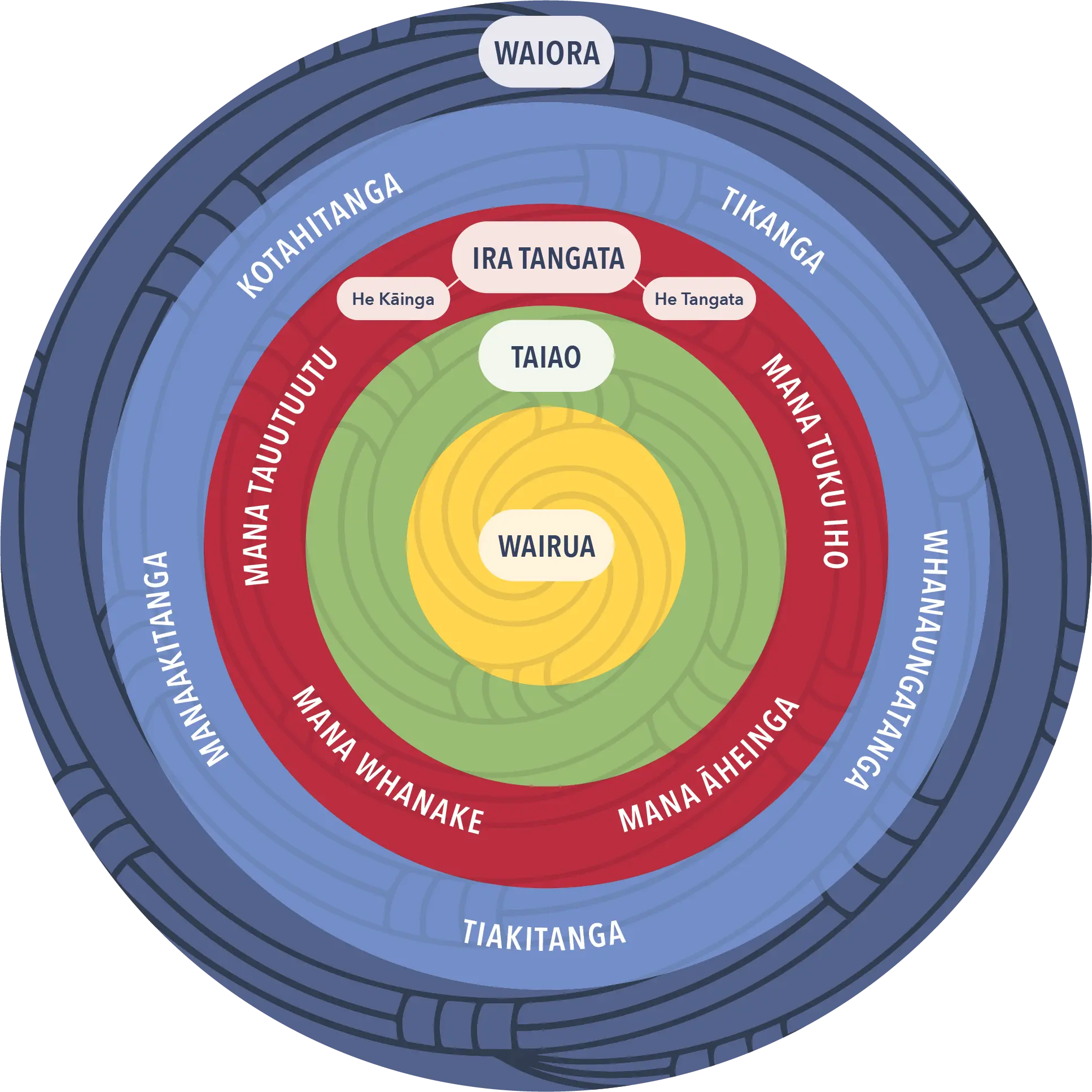
Treasury’s He Ara Waiora kaupapa framework
An example of such a guiding framework is He Ara Waiora, the wellbeing framework produced by Te Tai Ōhanga/The Treasury. According to Treasury He Ara Waiora ‘is a tikanga-based wellbeing framework… that presents a holistic, intergenerational approach to wellbeing’[13]
He Ara Waiora was originally developed over a tax reform project. The project led to kōrero with iwi and Māori thought leaders, academics and business leaders, wider engagement across the country for more than a year, from which a prototype emerged.
The framework is based in normative or value-based principles derived from te ao Māori, including kotahitanga, tikanga, whanaungatanga, manaakitanga and tiakitanga.[14] According to the authors Waiora itself can be loosely translated as ‘wellbeing’ but that has no direct equivalent in English.’[15]
He Ara Waiora was also designed to work alongside The Living Standards Framework, which itself was designed ‘to capture the different aspects of wellbeing and how they interact with each other. The main purpose is to provide a consistent approach to conceptualising wellbeing to support the Treasury to consider the broader impacts of our policy advice in a systematic and evidenced way.’[16]
Its working alongside the Living Standards Framework was designed to ensure ‘te ao Māori and Pacific concepts of wellbeing are woven into policy development with integrity.’[17]
Te Tiriti as a Kaupapa Framework
It could be argued that Te Tiriti o Waitangi is the ultimate Kaupapa Framework for this land.
Hobson and co were acting on the Instructions given to them by Lord Normanby, the Secretary of State for the Colonies, but it was almost entirely the work of James Stephen, the Permanent Under-Secretary who headed the Colonial Office.
Stephen in turn was highly influenced by Christian and humanitarian principles developed by the Clapham Sect, who had committed themselves to the eradication of the slave trade.
Their Christianity was not the historical cartoon of the imposition of a superior culture, but instead under the leadership of Henry Venn who ran the Church Missionary Society for 30 years, and was Stephen’s brother in law, sought to separate their English culture from their faith. Ven stated that indigenous people should ‘remain native in all respects, except in this, that they had become Christian, Christianity in them, becoming naturalized’[18]
One could draw a link between this acknowledgement of mātauranga (worldview) and the Treaty enshrining principles such as acknowledgement of Māori land ownership, which also implied an acknowledgement of Māori social structures and hence, mātauranga.[19]
Thus it is important to think of Te Tiriti o Waitangi as being shaped in a Kaupapa Framework that included a strong theological element as a key part of its guiding architecture.
It could be argued that Te Tiriti o Waitangi is the ultimate Kaupapa Framework for this land.
Conclusion
Kaupapa Frameworks are essential tools for leadership. They help create form out of chaos, and speak to our deep humanity as we seek to understand our relationships to one another and to Creation.
Kaupapa Frameworks push us to understand our values and how we live that out as an organisation. They create a space where we can understand our own values, and how they relate to our actions.
We need to understand our values deeply, and to live them out as “ethics” or tikanga. We need to live and breathe them, and Kaupapa Frameworks give us the context to do that.
Kaupapa Frameworks work well when told visually, as it helps to understand relationships between ideas and concepts. They also work well when storytelling goes alongside and is woven through, as lived – or even ancestral – experiences bring these to life.
What are your Kaupapa Frameworks? For your whānau? For your work? For your life?
Download the PDF here
Dr Hirini Kaa
September 2025
[1] Koi Tū Centre for Informed Futures, Social cohesion: New Zealand’s precious and fragile asset, 2025, p.3.
[2] Joseph Campbell, The Hero with a Thousand Faces, (Princeton: Princeton University Press, 1949)
[3] Walter Brueggemann, An Introduction to the Old Testament, (Louisville: Westminster John Knox Press, 2003.), p.34.
[4] Maori Marsden, The Woven Universe, (Otaki: Te Wanaga o Raukawa, 2003), p.31.
[5] Henare Tate, Towards Some Foundations of a Systematic Māori Theology, PhD Thesis, Melbourne College of Divinity, 2010, p.68.
[6] Smith Education
[7] Maryna Lakhno, ‘What Is a Policy Framework? An Attempt at Conceptualization’, Social Studies 1, (2023), p.89.
[9] Thomas Dye, Understanding Public Policy, (Pearson, 1972), p.2.
[10] Lakhno, pp.93-96.
[11] Elinor Ostrom, Background on the Institutional Analysis and Development Framework, The Policy Studies Journal, Vol. 39, No. 1, 2011, p.8.
[12] Lakhno, p.103.
[13] Treasury, He Kāhui Waiora: Living Standards Framework and He Ara Waiora COVID-19: Impacts on Wellbeing, 2020, p33.
[14] Treasury, p.42.
[15] Treasury, Te Tai Waiora, 2022, p.19.
[16] Treasury, Te Tai Waiora p.18.
[17] Treasury, p.43.
[18] C. Peter Williams, ‘The Church Missionary Society and the Indigenous Church in the second half of the Nineteenth Century: The Defence and Destruction of the Venn Ideals’, in Dana L. Roberts ed., Converting Colonialism: Vision and Realities in Mission History, 1706-1914, Grand Rapids, 2008, pp.89-90.
[19] In this I draw on the work of Ned Fletcher, ‘A praiseworthy device for amusing and pacifying Savages?’, PhD Thesis, University of Auckland, 2014